Therapy
History
- Early treatment “Trepanning” - drilling a hole on the skull so that the soul can leave
- “Bedlam” asylum
- Modern Therapies
- Insight Therapies, aka. talk therapy
- Cognitive-Behavioral Therapy
- Drug Therapy
Insight Therapy
Insight Therapies - psychoanalysis
- Started by Sigmund Freud
- The patient does not know what the real problem is (e.g. sexual abuse in the childhood), defense mechanism has built up
- But, we cannot do direct confrontation, as it will bring up the defenses of the patient
- Free association, dreams, other projective tests
- Counter Transference: the therapist is taken as the abuser, a therapist need a therapist
Humanistic Therapy
- Humanistic Therapy - Client-Centered Therapy
- e.g. Carl Rogers
- Non-directive, no patient, only client
- Incongruence - the distance between who they are and why they want to be
- Limitations
- A client must be intelligent, articulate, motivated, and perhaps rich enough
- Not many scientific studies assessing effectives.
Cognitive Behavioral Therapy
- Systematic Desensitization, based on
Classical Conditioning
- Relaxation
- Learn to relax.
- Associate feeling with a trigger.
- Practice using the trigger.
- Hierarchy of Fears
- Create Hierarchy.
- Go through it slowly, using trigger.
- One cannot progress until they can remain relaxed on the previous step.
- Relaxation
- Therapies based on Operant Conditioning
(all about consequences)
- Reinforcement of Adaptive Behaviors
- Token Economies
- Punishment
graph LR
A[Negative Event]
B1[Rational Belief]
B2[Irrational Belief]
C1[Healthy Negative Emotion]
C2[Unhealthy Negative Emotion]
A --> B1 & B2
B1 --> C1
B2 --> C2
- CBT and Depression
- Write down all the good things and ignore all the bad things.
- At the end of the day, read the good things to yourself.
Biological Treatments
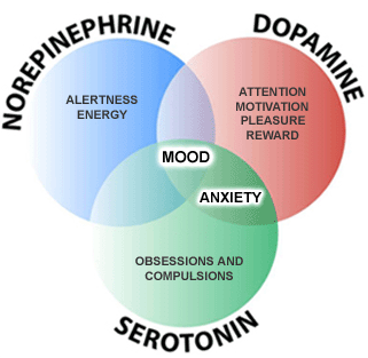
- Transmitters
- Norepinephrine and Serotonin are involved in whole brain, Dopamine is more mid-brain-ish.
- The brain is complex, thus drugs may be addictive.
- Anti-maniac and anti-depression drugs
- Tricyclics: Slow the up-take of norepinephrine and serotonin. Many side effects (e.g. weight gain, poor concentration.)
- Monamine Oxidase Inhibitors (MOI): Prevent enzymes from destroying norepinephrine and serotonin. Many side effects (e.g. high BP, blurred vision, insomnia)
- Selective Serotonin Re-uptake Inhibitors (SSRI): Fewer side effects, which allows for larger doses
- Lithium Carbonate: Most effective for bipolar disorder or mania. Ends manic episodes as soon as blood level is high enough, and when mania is contained depressive periods also end.
- Anti-psychotic drugs
- Schizophrenia is biological issue. Drugs are good at dealing with positive symptoms.
- Long term use of drugs lead to tardive dyskinesia (lip smacking, drooling)
- Psychosurgery and Electro-Convulsive Shock