Memory
- For human memory, see Memory.
Hardware
- Bus Timing diagram
- RAM
- SRAM
- DRAM
- ROM
- EEPROM
- EPROM
- Flash
- MMU
Segments
- Memory space for a program/process is separated into logical segments.
- Code, Data, Heap, and Stack
- “Segmentation Fault” means segments are used improperly.
- “Each process has an illusion of having all memory in the machine”. Additional pages are allocated when they are needed.
breakpointer andstack ptrmarking the boundary of heap and stack.
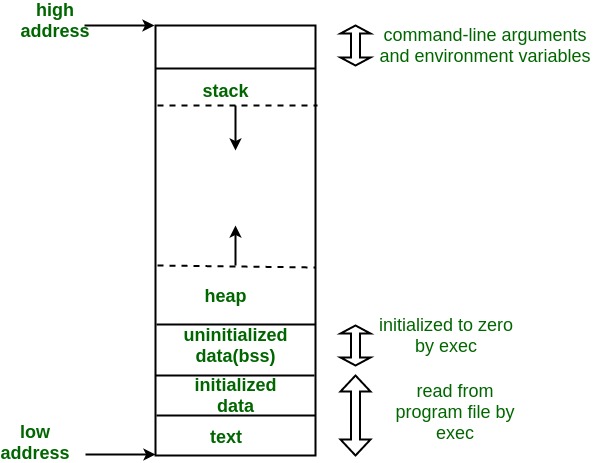
Stack
For data structure, refer to stack. For function call using stack, see Function Call.
- A guard page is paced around stack, accessing this not yet allocated page triggers page fault and new pages will be allocated for stack.
- Push and pop of the stack, stack pointer is modified accordingly.
Heap
Fro data structure, refer to heap.
- Heap is treated as a doubly linked-list of chunks.
progcallsmalloc, which callssbrkto request additional page.- A struct is used to keep information about chunks in the heap. This struct is paced at the head of each chunk.
- Calling
free(p)is equivalent top->state = FREE. (change it to free) Adjacent free chunks are also merged.
struct chunk {
    enum {FREE, USED} state;
    int checksum;
    int size;
    struct chunk *next;
    struct chunk *prev;
};
How does Valgrind work?
- Always request a new page for memory allocated.
- Also request a page at the front and at the end of the page allocated.
- Mark these two extra pages as invalid.
- Thus we get to know which memory reference caused exception.
- This process is slow and costs a lot more memory.
- Heap Fragmentation and Garbage Collection. Moving all blocks can only be done in dynamic language with Garbage Collection (since we need to “announce” this change of address to pointers.)
- Preventing fragmentation? Delay fragmentation by changing the behavior of
malloc.- First fit
- Best fit = choose the smallest chunk that fits
- Worst fit = choose the biggest chunk that fits
- Next fit = remember last success, and start from there next time. Constructive laziness. It's simple, and doesn't do any thing bad.
Locating Data
- Global data
- Referenced by name in assembly language
- By absolute address - however, the address might be too long
- By address relative to the data segment
- By address relative to the PC
- Local data - as an offset to the current frame pointer
- Heap data - by the pointer
Loading
- Executable Formats
- Binary blob
- All the segments are dumped into this binary.
- A lot of spaces are wasted. e.g. a large global array initialized as all 0.
a.outExecutable Format- The first assembler outputs to
a.out - Header contains a magic number to define executable, and sizes of each segments, as well as entry point.
- Header → Text → Data → Symbol
- The first assembler outputs to
- Extensible Linking Format (ELF), contains a section table, supports dynamically linked libraries.
- Binary blob