The Social Minds
Conformity
- Push-pull - we want to individuate, but also belong to a group
- Asch experiment, volunteer vs confederates, which lines have the same length? We tend to follow the herd.
Authority
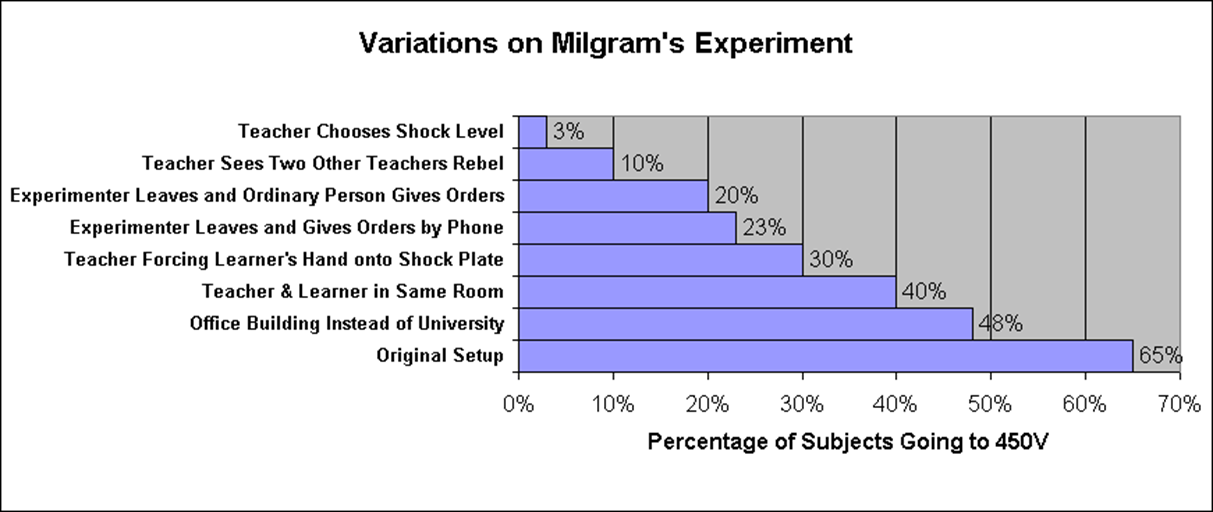
- Stanley Milgram experiment
- Confederate is always made the learner, volunteer is always made the teacher
- Teacher and hear and speak to the learner
- After each wrong answer, experiment conductor will require the teacher to shock the learner with higher voltage
- People follow authority even when they think it’s wrong
Protecting the Self
- Self-serving bias
- We tend to attribute failure to the environment, success to ourselves.
- Which is helpful for our recognizing our own value.
- Depressed individuals do the opposite
- Just World Hypothesis
- We tend to think victims must be guilty and deserve what happened to them.
- Underlying logic: Our desire for security. “If we don’t deserve it, bad things won’t happen to us.”
- External vs Internal Locus of Control.
- Can we determine what happens?
- Disempowerment, shifting the locus of control to the external, makes Alzheimer patient become nasty.
Good People Do Bad
- Stanford Prison Experiment by
Philip Zimbardo
- At the beginning prisoners joke with the guards. Then a guard decided to “exert control on the prisoners.”…
- Prison culture then emerged. Guards act oppressive.
- “The Lucifer Effect”. Bad apples… When we’re in the context, any of us could behave in that certain way…
Bystander Interference
-
Kitty Genovese Case
- It was estimated that 30 to 40 people in the apartment heard the scream. However, nobody came out to help Kitty.
-
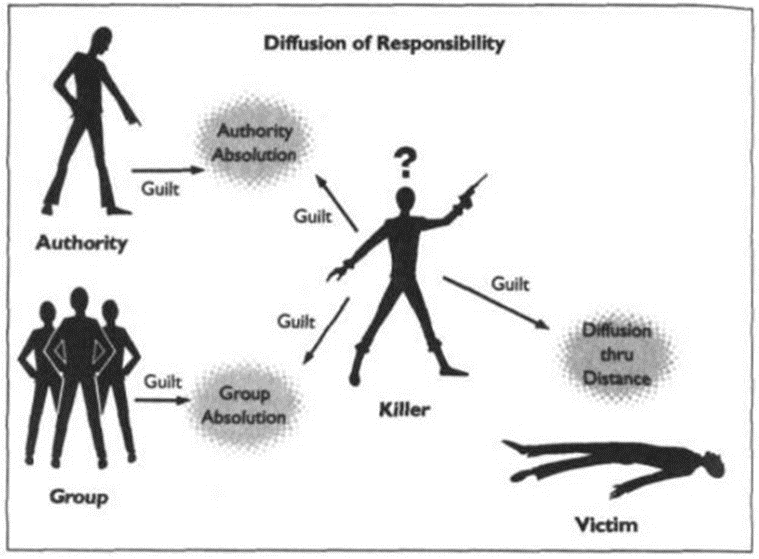
Bystander Effect = The more people there are that could help, the less likely any will help.
-
- Responsibility is diffused among the group.
- Somebody is more capable.
- Or, the distance of the victim also diffuses your feel of guilt.
Schema, Stereotypes and Prejudice
- Generalization and Discrimination; Sometimes this could be applied to people…
- Schema = the cognitive script that we follow when entering into a familiar or similar situation
- Indirect experience
Competition, Ignorance, Fear and Prejudice
- In-groups and out-groups
- Robber’s Cave Experiment by Muzafer
Sherif
- Similar kids were randomly assigned into two groups
- Stage 1: Create in-group identities such as names, flags, in-group activities.
- Stage 2: Add in cross-group competition.
- Prejudice emerges! Kids rate very positively to their in-groups, but act prejudicial to the out-groups.
- Stage 3: Have groups join forces to defeat a “common enemy”.
- At this point, the bias decreased. Kids know each other more.
- Basis of prejudice: lack of knowledge.
Attraction
- First impression matters. Positive adjectives first or negative ones first? The first words set the tone!
- Animals don’t have sense of attraction based on beauty. They do so based on heat and odor.
- In human world, long-term relation must be formed in order to raise off-springs.
- Humans like averaged (symmetrical) face. Average is Beautiful! We’re attracted by symmetry.
- Large pupils are attractive. Interest increases the size of the pupil. We like people who like us.
- Waist to Hip Rate = 7/10. Which is related to less health problems, and higher survival rate in child birth, more likely to give birth to healthy and more children.