How Music Works, It’s Magic
Rhythm
“Classical music is music without Africa”.
- Undifferentiated beats convey a consistent pulse.
- Our brain unconsciously group pulses into group of 2, 3, 4.
- Meter = pattern of repeated beats.
- Duple meter = strong, weak…
- Triple meter = strong, weak, weak…
- Measure lines/Bar lines.
- Two axes of music = pitch + duration
- Neume → Notea (Note)
- Duple division of notes
- Downbeat and Syncopation
- Syncopation usually in melody, beat usually in bass
- “Downbeat” - conductor’s hand goes down - to convey meter
- Duration + Accent + Range + Chord Changes
- Tempo = Speed of beats
- People dance with steady beat
- We may create accelerando or ritardando
- Reality is on the beat, art is off the beat.
| Tempo Marking | Speed (BPM) |
|---|---|
| Lento | 40-45 |
| Largo | 45-50 |
| Adagio | 55-65 |
| Andante | 73-77 |
| Moderato | 86-97 |
| Allegretto | 98-109 |
| Allegro | 109-132 |
| Vivace | 132-140 |
| Presto | 168-177 |
| Prestissimo | 178+ |
Melody is the Star
- Melody = a coherent collection of pitches animated by a rhythm and usually by a harmony
- Higher frequencies disappear more quickly but sounds clearer.
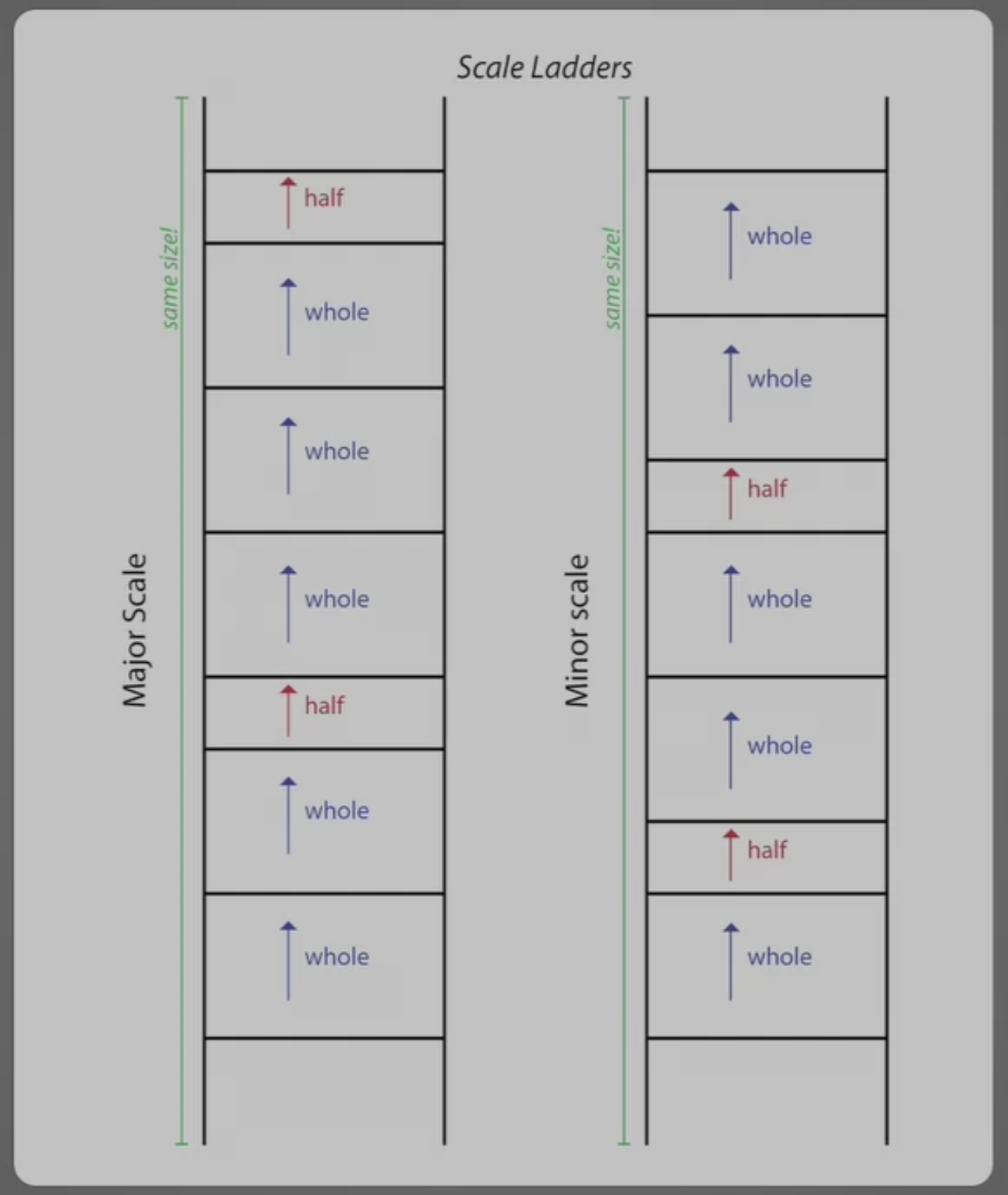
- Scale = adjacent notes going up or down
- China - Pentatonic scale
- India - Six notes scale
- Western - Seven notes scale - settle by ancient Greeks
- Octave duplication - two-to-one ratio
- Chromatic scale
- all twelve possible pitches - as black keys filled the keyboard
- Adds richness/variety/tension (ascending), or releases the tension (descending)
- Mode and Mood
- Minor sad, Major happy - it’s nurture, not nature.
- Major/Minor Mode Scale, the third interval of the scale.
- Changing the mode → changing the mood.
- Tonic of Melody
- The first note of the scale.
- All melodies end on tonic.
- Tonality = Key
- Modulation
- = change of key
- You can hear it’s modulated, but you don’t know where to, unless you possess absolute pitch.
- Pump up modulation at the end of pop songs.
- Melody
- Antecedent and Consequent phrases - away phrase and back home phrase
- The more jumps and leaps in the melody, the harder to sing along
- Disjunct melody vs conjunct melody
The Harmony of Music (and Life)
- Harmony
- Music in most of the cultures go without harmony.
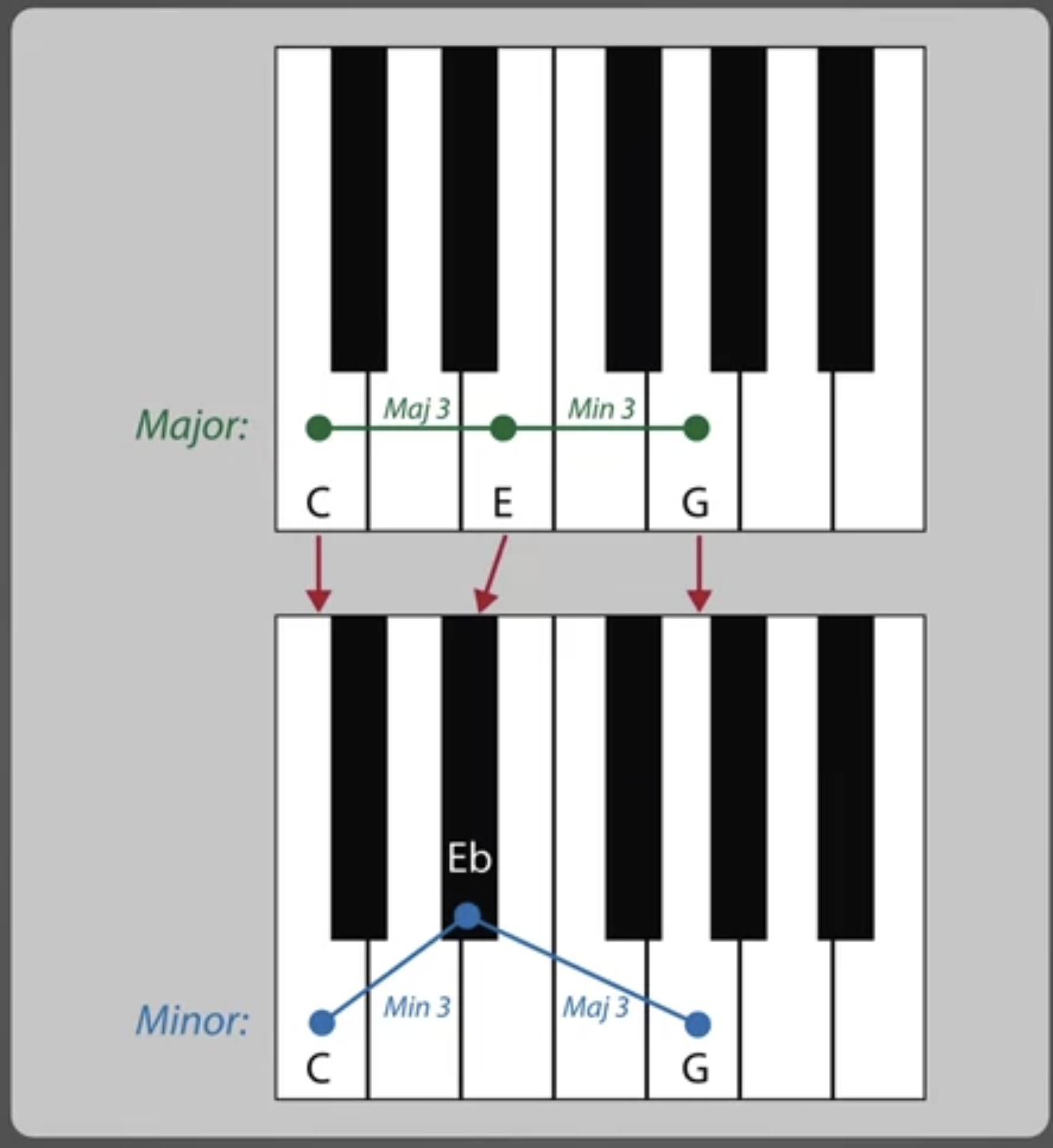
- Harmony formed by chords = simultaneously sounding two or more pitches, specifically triads
- Tonic → VI Subdominant → V Dominant → Tonic
- Chord Progressions and Cadence
- Harmony must be changed to fit the melody to create consonance
- The end of the progression is the cadence = a fall to the end
- Authentic Cadence = V → I
- Deceptive Cadence = unexpected, V → VI
- “Amen” Cadence = VI → I
- Half Cadence = to create a pause, I → V
- Three types of listening
- Analytical - “What’s going on?”
- Technical - “How well are they doing it?”
- Emotional - “How do I feel about the Music?”
- Chord
- Arpeggio = play the notes in a chord in succession
- Ostinato = harmony/melody/rhythm repeating again and again
- Canon = round, one voice starts out, the others duplicate it exactly
- Major and Minor triads differ by a half-step in the middle